Article
The $19 Microsoft Office "Lifetime License": What You're Actually Buying
Microsoft sells Office Home 2024 for $179.99. Groupon, Facebook ads, and a long list of CD-key sites will sell you what looks like the same thing for $19 to $39, marked “lifetime license,” often with a Microsoft partner badge and a Trustpilot score attached. This article explains what those cheap keys actually are, why they work at first and stop working later, and what to do if your real goal is just to spend less.
I worked at Microsoft for years, which made me the guy my family called before buying Office, and the advice I’ve given most often is some version of “don’t buy a license key from that site.” This article is the long version.
What a $19 Office key actually is
Microsoft sells Office two ways to consumers: a one-time purchase (Office Home 2024) and a Microsoft 365 subscription. It also sells volume licenses to businesses and academic keys to institutions, in bulk, at steep per-seat discounts, under contracts that say those keys can’t be resold to individuals.
The cheap keys are almost always those volume or academic keys, split up and resold one at a time. The giveaway is right in the product names. These sites sell “Office Professional Plus” for Windows and “Office Standard” for Mac, alongside Visio and Project keys. Those are volume-licensing editions. Microsoft has never sold Professional Plus or Standard to individuals at retail. When you see a business-edition SKU offered to a regular person, you’re looking at the gray market by definition.
So the software is real Microsoft software, and the key usually activates. That’s what makes these listings persuasive. The problem is what happens next.
Why it works in August and dies in October
Microsoft can revoke a key whenever it determines the activation wasn’t legitimate, and with resold volume keys, it eventually does. Nothing about the purchase protects you when that happens. The reseller’s support desk can issue you a replacement key, which is another key from the same pile, on the same clock.
You can watch this play out in the resellers’ own reviews if you read past the star rating. The pattern repeats across sites:
- Buyers report receiving a code that was already in use on someone else’s machine, then needing support to issue a replacement. A legitimate retail key is generated once and sold to one buyer, so it can’t arrive “already in use.” A volume key shared across many buyers can.
- One review captures the whole lifecycle in a sentence: the key activated immediately, then about ten months later the license flipped to expired.
- Across pages of feedback, the shape holds: fast delivery, friendly support, and a steady undercurrent of keys that fail and get swapped.
A high Trustpilot score built on week-one reviews tells you the checkout works. It tells you nothing about month ten. Nobody goes back to update a five-star review when their license dies during midterms.
The Microsoft partner badge trick
The most convincing version of this I’ve seen was a Groupon listing that invited shoppers to “verify our Microsoft Partnership” with a link to a real page on microsoft.com. That feels like proof. It isn’t, and it’s worth understanding why, because the same move shows up everywhere.
Microsoft’s Marketplace lets partner companies create listings. Appearing there means a company registered as a partner. It is not an endorsement and not a license audit, and it is certainly not permission to resell volume keys to individuals. Read closely, the partner page endorses nothing about what the company sells or how it sources keys. The badge exists to make you stop asking the question you should be asking, which is: how is $19 possible for something Microsoft charges $179.99 for?
Borrowed trust is the whole playbook. A real microsoft.com URL, a real Trustpilot widget, a real BBB profile (check the complaints tab, not the letter grade), all arranged around a price that none of those things actually vouch for.
The Facebook ad version
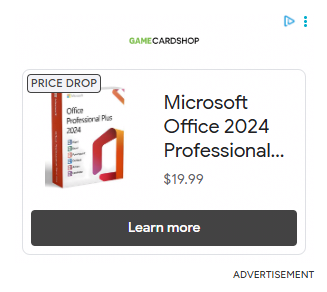
The same inventory reaches you through Facebook and Instagram ads pointing at CD-key sites. Many of these stores are not fly-by-night operations. Some have been running for a decade, mostly selling game keys, with Office keys as a sideline. Longevity makes them more persuasive, not more legitimate. A ten-year-old storefront selling “Office 2024 Professional Plus” for $19 is running the same volume-key resale as the Groupon listing, just with better branding and a bigger ad budget.
One listing, every trick at once
In July 2026, a Facebook ad led me to a Groupon listing that runs the whole playbook on a single page, so it makes a useful specimen. The headline: “Official Lifetime License to Microsoft Office 2024 Standard For PC or Mac.” The Mac version was $39, marked down from $149.99, with a promo code dropping it to $31.29 and a countdown timer. A banner said over 100 people bought it that day.
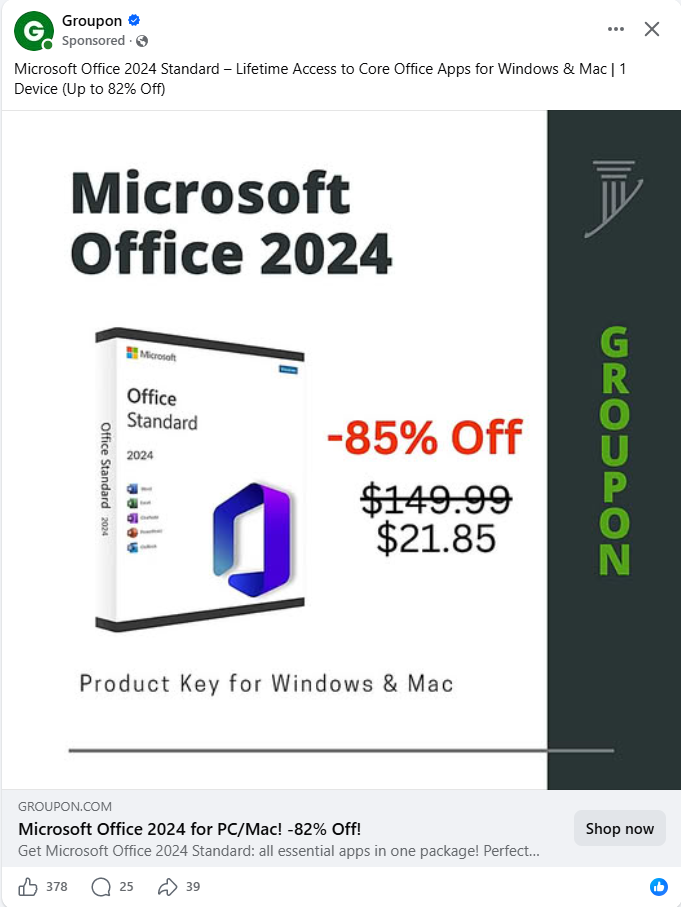
Start with the product name. Microsoft sells two Office 2024 editions to individuals: Office Home ($179.99) and Office Home & Business ($249.99). There is no retail product called “Office 2024 Standard.” Standard is a volume-licensing edition sold to organizations. The $149.99 strike-through price is a reference to a retail price that has never existed, which makes the 74% discount a percentage of a fiction.
The listing carried the Microsoft Marketplace badge covered earlier, inviting shoppers to verify the seller’s partnership. Same move, still working.
Then comes the part no warning article could stage. Groupon listings let customers upload photos, and the buyers of this deal did. One photo shows Microsoft’s own Activation Wizard on a fresh install, explaining that this copy of Office is designed for corporate or institutional customers, directing the buyer to connect to their corporate network, and noting that software not purchased for corporate use may be counterfeit. Another customer photo shows the product naming itself: Microsoft Office LTSC Standard 2024. LTSC stands for Long Term Servicing Channel, an edition that exists only in volume licensing. The listing’s own review gallery contains Microsoft identifying the product as a corporate license sold to the wrong customer.
The reviews around those photos followed the pattern exactly: 4.2 stars across more than 44,000 reviews, every visible one posted within the previous few hours, praising fast delivery and helpful support. And down in the fine print, Groupon states the merchant is solely responsible to purchasers for the care and quality of the goods. The merchant, in this case, is an email address. When Microsoft eventually flags the key, that email address is the entire support structure, and Groupon’s role ends at the receipt.
One more detail worth noticing: the listing promised Microsoft security updates through October 9, 2029. That’s a real date. It’s the genuine end-of-support date for Office 2024, borrowed to dress up a license Microsoft can switch off years earlier. The most effective gray-market listings aren’t built from lies. They’re built from true facts arranged around the one fact that matters.
The tells, all in one place
You don’t need to research every deal. If a cheap Office listing shows several of these, the price is the warning:
- A business or academic edition name (Professional Plus, Standard, Education) sold to individuals
- A price under $50 for something Microsoft lists at $179.99
- “Lifetime license” language for products Microsoft doesn’t sell that way
- Trust signals that point somewhere real but prove nothing: partner badges, marketplace links, star ratings
- A stack of recent five-star reviews and almost nothing about how the license held up a year later
The legal version of the same mistake
Not every bad Office deal is gray market. Sometimes a completely legitimate store sells you a genuine license at a real discount, and it’s still money mostly wasted, because the product is near the end of its supported life.
A recent example: in July 2026, Woot, Amazon’s deals site, sold Office Home & Business 2021 for Mac at $49.99 and called it 79% off. Everything about the transaction was honest. Woot is owned by Amazon, the license was genuine, and the discount math was accurate. What the listing didn’t mention is that Microsoft ends all support for Office 2021 on October 13, 2026, with no extension and no extended security updates. Three months after buying it, every newly discovered security hole in those apps would stay open forever. In the same sale, the same store sold Office Home 2024 for $114.99 with security updates through October 2029. The smaller discount was the better deal by a wide margin.
Mac buyers should hold old Office versions to an even higher standard, because “the apps will keep working” has recently grown an asterisk. In 2023, Microsoft told Office 2019 for Mac owners their apps would continue to function after support ended. In July 2026, a licensing certificate expired and those Mac apps dropped into read-only mode: documents open and print, but editing is gone. Microsoft renewed the certificate, but delivers it only through software updates that Office 2019 can no longer receive. The Windows version was unaffected. Whatever you think of that decision, it established something Mac buyers need to price in: a perpetual license on a Mac keeps working at Microsoft’s discretion, and Microsoft has now let one lapse.
So add a second habit alongside checking the product name: check the support end date. A gray-market key fails because the license was never yours to buy. A clearance-priced old version fails slower and more politely, but a big percentage off software in its final supported months is a discount on the past.
What to do instead
If the goal is to spend as little as possible, you have real options that carry none of this risk.
Free, and genuinely fine for a lot of people:
- LibreOffice is free, opens and saves Word, Excel, and PowerPoint files, and handles most everyday work. For writing documents and building spreadsheets it is more than enough.
- Microsoft’s own web apps are free with a Microsoft account. Word, Excel, and PowerPoint run in a browser at office.com at no cost.
- Students and teachers: check with your school before buying anything. Many schools provide Microsoft 365 to students and staff for free, and people pay for things they already have access to all the time.
If you want the real desktop Office:
- Office Home 2024 is $179.99 once and yours to keep. Microsoft 365 Personal is $99.99 a year and adds 1 TB of cloud storage, ongoing updates, and the AI features.
- Buy from Microsoft directly or from a normal retailer you’d trust with anything else. Genuine Office goes on sale at sensible discounts. Woot’s July 2026 sale had Office Home 2024 at $114.99, a real 36% discount from a legitimate Amazon-owned store. Real deals exist and come back a few times a year; we track current ones on the deals page. They just don’t look like 90% off.
The honest bottom line
A $19 Office deal is not nothing. You usually get working software for a while. What you’re really paying for is a license that can be switched off later with no one to help you, in exchange for saving around a hundred and fifty dollars one time. For most people that trade isn’t worth it. If a price looks too good to be true, that is usually the most accurate thing about it.
No affiliate links appear in this article.